
From reality to ambition

A review of current progress and the journey ahead

Environmental risk management for banks and asset managers

In the third quarter of 2023, PwC Singapore conducted a survey across 50 financial institutions with operations in Singapore, comprising 26 asset managers and 24 banks of various sizes and profiles, to reflect on the industry's progress in operationalising the MAS Environmental Risk Management (ENRM) Guidelines since they came into effect in June 2022. Overall, good progress has been made across the board and while many observations are consistent with those highlighted in the Monetary Authority of Singapore (MAS) information papers published in May 2022, this study further explores nuances amongst smaller financial institutions, including foreign-headquartered banks and asset managers placing reliance on group policies and capabilities, and shines a spotlight on upcoming topical areas such as transition planning, International Sustainability Standards Board (ISSB) and Taskforce on Nature-related Financial Disclosures (TNFD).

Key takeaways

While most financial institutions have made good progress in formalising roles and responsibilities of the BSM in environmental risk governance, reporting to BSM on environmental risk matters could be further enhanced, including in areas such as developing quantitative key risk indicators for reporting and communicating results of scenario analysis to inform strategy (including risk appetite) setting.​

Financial institutions generally have established policies and frameworks to document their approach towards managing environmental risk, with many leveraging head office's frameworks and policies (where they are part of a group) to accelerate ENRM implementation. However, the extent of head office reliance varies amongst foreign-headquartered financial institutions, with Asian banks generally facing more challenges when placing reliance. Degree of integration within the wider enterprise risk management framework varies as well, with most banks focusing mainly on credit risk management at the moment.

Transition planning is at an early stage for banks and asset managers in Singapore, with more progress where they are part of a group in which carbon reduction commitments have been made. Locally, most banks have yet to establish transition finance strategies, and customer engagement plans or formal risk mitigation measures for customers that do not manage environmental risk adequately. Meanwhile, few asset managers surveyed have set transition-related targets. These would be areas of focus for financial institutions as they progress beyond environmental risk management to transition planning at the business and strategic levels.

With the exception of a number of smaller financial institutions, the majority of respondents have embarked on quantitative climate scenario analyses, albeit in varying stages of maturity and coverage. Close to half of respondents rely on external vendors and platforms as they are still developing capabilities internally, and more than a third of banks rely on the analyses performed at the group level rather than perform local assessments. A phased approach focusing on the high risk sectors and asset classes (for asset managers) is commonly observed.

Most financial institutions have made public disclosures of their approach towards environmental risk management. TCFD is the most commonly referenced disclosure framework presently, but a good number of financial institutions have set their eyes on TNFD and ISSB. On emissions reporting, business travel and financed emissions are the most commonly disclosed Scope 3 emissions amongst banks and asset managers. Only 15% of asset managers have obtained external assurance over their disclosures, compared to 63% for banks (albeit mostly at the group level).

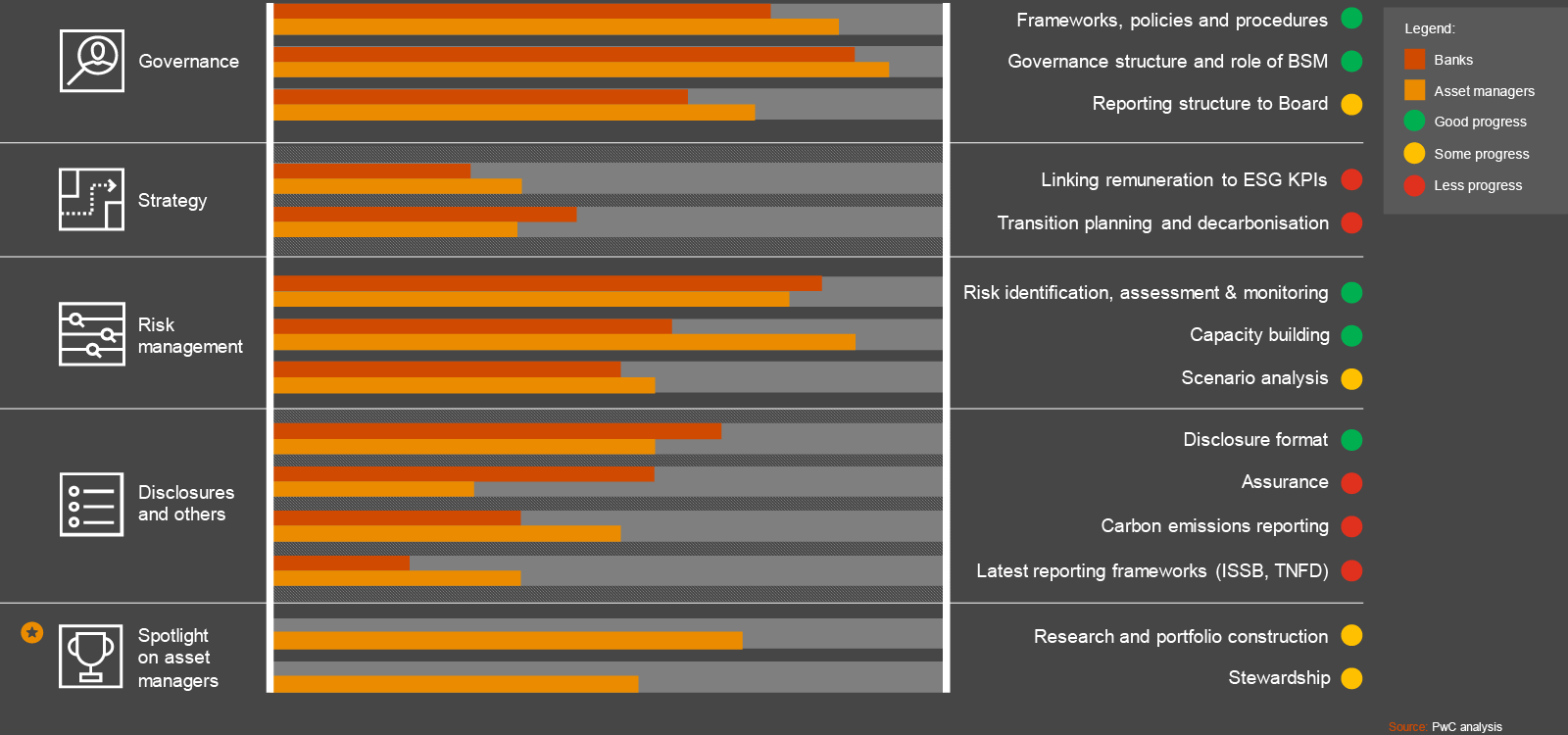
Implementation progress at a glance​

Implementation maturity by banks and asset managers in Singapore:

Implementation maturity by banks and asset managers in Singapore

Survey methodology

In Q3 2023, PwC Singapore conducted an industry survey across the banking and asset management sectors. The survey reflects on where our local financial institutions are at in terms of operationalising the MAS Environmental Risk Management (ENRM) Guidelines and assesses plans for upcoming topical areas including transition planning, Task Force Nature-Related Finance Disclosures (TNFD) and International Sustainability Standards Board (ISSB) for the banking and asset management sectors.​

The survey was conducted across 50 financial institutions (FIs) with operations in Singapore. The 50 respondents were split between 26 asset managers and 24 banks.

Breakdown of respondent profile

Banks
Asset managers

A look back at our closed-door discussion

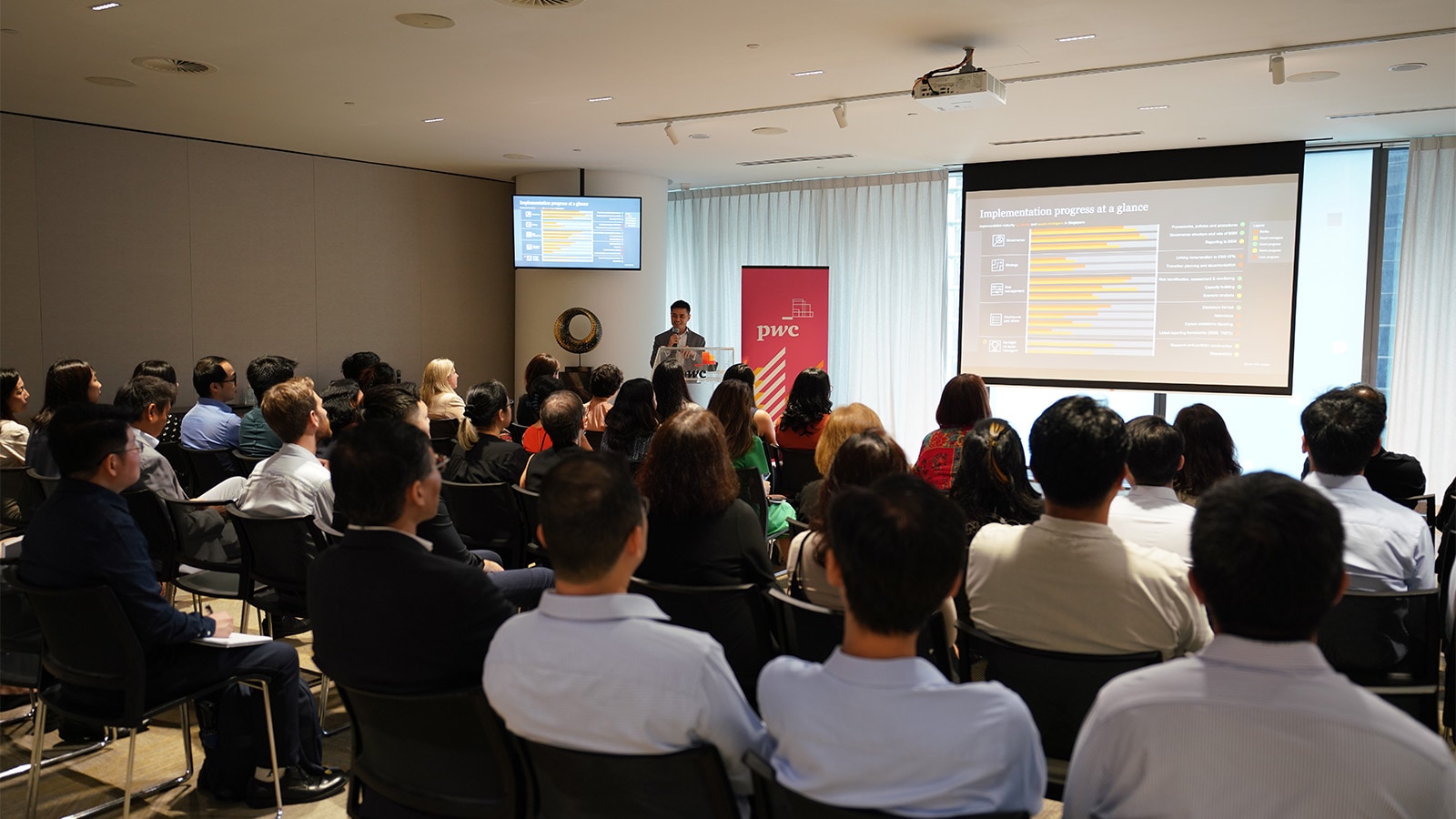
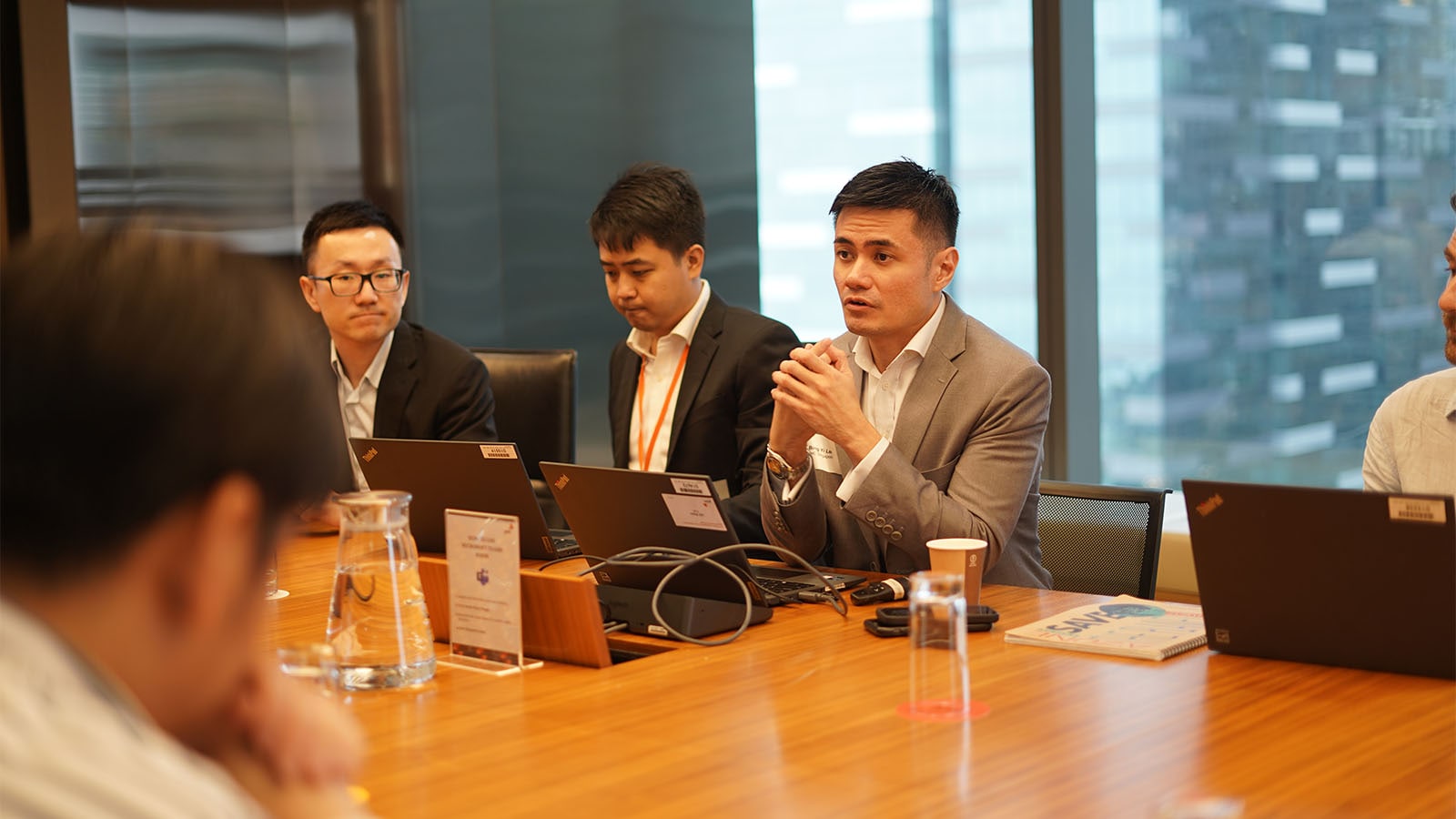
PwC Singapore held a closed-door discussion where we shared key insights and results from the recent industry survey and around the topic of transition planning for financial institutions. Followed by an industry group roundtable to discuss key environmental, social and governance (ESG) topics impacting asset managers and banks.

Contact us

Fang Eu-Lin

Sustainability and Climate Change Practice Leader, PwC Singapore

+65 9817 8213

Email

Bing Yi Lee

Partner, Sustainability and Climate Change, PwC Singapore

+65 9782 6395

Email

Christina Mason

Partner, Asset and Wealth Management ESG, PwC Singapore

+65 9018 1559

Email

gsap_scrolltrigger

Follow us

Required fields are marked with an asterisk(*)

By submitting your email address, you acknowledge that you have read the Privacy Statement and that you consent to our processing data in accordance with the Privacy Statement (including international transfers). If you change your mind at any time about wishing to receive the information from us, you can send us an email message using the Contact Us page.

Hide